Berliner Originale and BerlinDiscoveries are our new formats for photography from the capital. Once a year, f³ – freiraum für fotografie transforms into a platform that makes the diversity of photographic perspectives from Berlin visible. In two parallel exhibitions, we present iconic works by renowned photographers from Berlin and offer the opportunity to discover new talents.
As the opening of this series, no one is more fitting than the native Berliner Robert Lebeck. He is one of the defining figures of photojournalism in postwar Germany. In an era when the country was reorienting itself and global politics were in flux, he developed a visual language that did more than document, it told stories. Born in Berlin in 1929, the self-taught photographer began working as a photojournalist in 1952, initially for various newspapers, and later for illustrated magazines such as Revue and Kristall. He worked for over three decades for the magazine Stern. His work, shaped by empathy and curiosity, forms the visual memory of the young Federal Republic.
Lebeck traveled around the world and photographed in major cities as well as rural regions, at political events and in everyday life. He portrayed politicians, artists, and intellectuals just as much as people far removed from the public eye. All of his photographs convey a sense of closeness and capture his subjects in authentic moments of openness.
He became famous for his 1960 report from the Congo: during the independence celebrations, a young man snatches the ceremonial sword from the King of the Belgians, a single fleeting moment in which the end of colonial power structures becomes visible. Such photographs established Robert Lebeck as a chronicler of times of upheaval. Yet his quieter observations behind the scenes of major events are just as significant: the world star Romy Schneider in striking vulnerability, exhausted prisoners of war returning home at the Friedland camp, Elvis Presley fans celebrating in East Berlin, or the grieving Jacqueline Kennedy at the coffin of her husband, the U.S. president who was assassinated in 1963.
Robert Lebeck was a pioneer of photojournalism: his images combine journalistic precision with poetic depth. They tell of a world in transition—and of the people within it.
Biography
Robert Lebeck was born in Berlin in 1929. During his studies in ethnology in Zurich and New York, he became interested in the photojournalism of magazines such as Life and Look, which led him
to pursue a career as a photographer. From 1952 onward, the self-taught photographer worked for various newspapers, and later for illustrated magazines such as Revue and Kristall. For more than thirty years, he worked as a photo reporter for Stern, interrupted only by a one-year position at Geo, where
he served as editor-in-chief from 1977 to 1978. His work earned him numerous awards and honors, including the Dr. Erich Salomon Prize of the German Society for Photography in 1991 and the Henri Nannen Prize for lifetime achievement in 2007.
In addition to his work as a photographer, Robert Lebeck also made a name for himself as a collector. His collection documents the history of photojournalism and comprises more than 30,000 items, including first editions and unique copies of newspapers, journals, and magazines dating from 1839 to 1973. Robert Lebeck died in Berlin in 2014.
OPENING: Thu., May 21, 2026, 7–9 PM. Speakers: Katharina Mouratidi, Artistic Director f³ – freiraum für fotografie, and Cordula Lebeck, Archive Robert Lebeck. Free admission!
In cooperation with Archiv Robert Lebeck
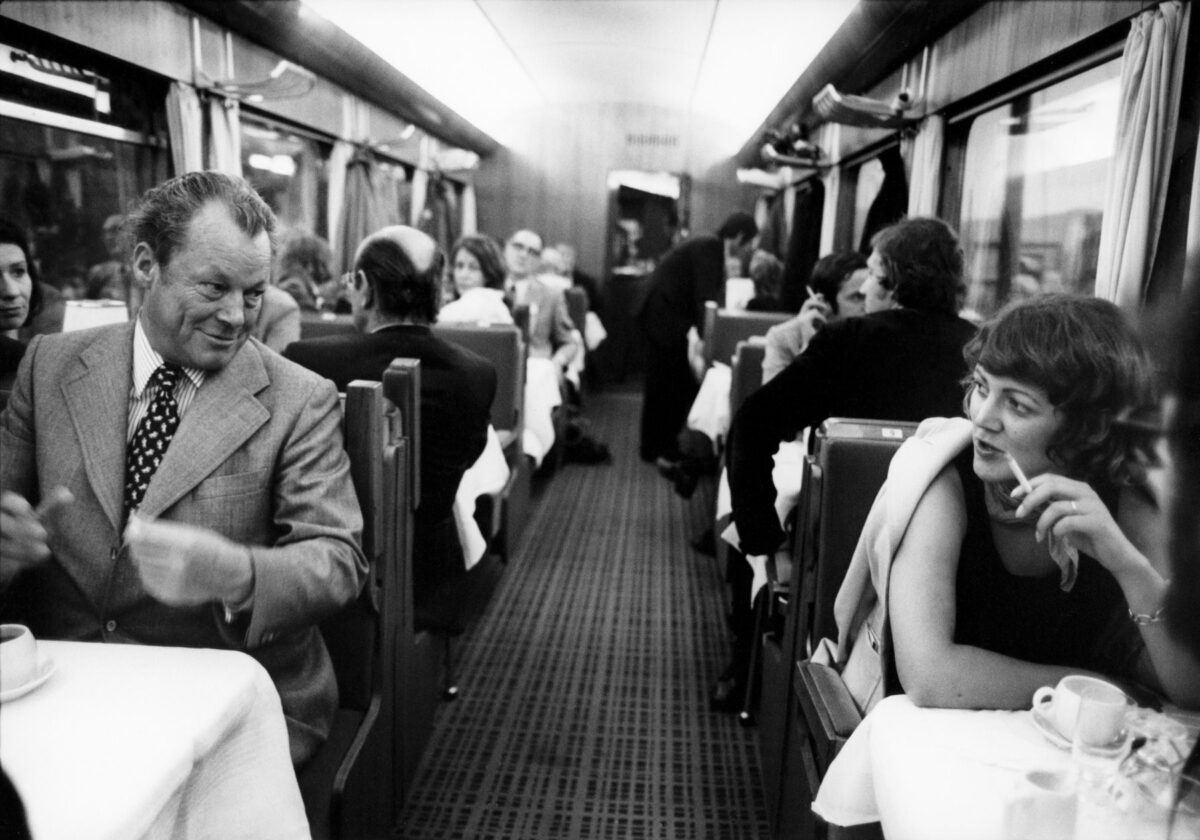
Image: Willy Brandt in the dining car while on an election campaign tour, southern Germany 1973 © Archiv Robert Lebeck