
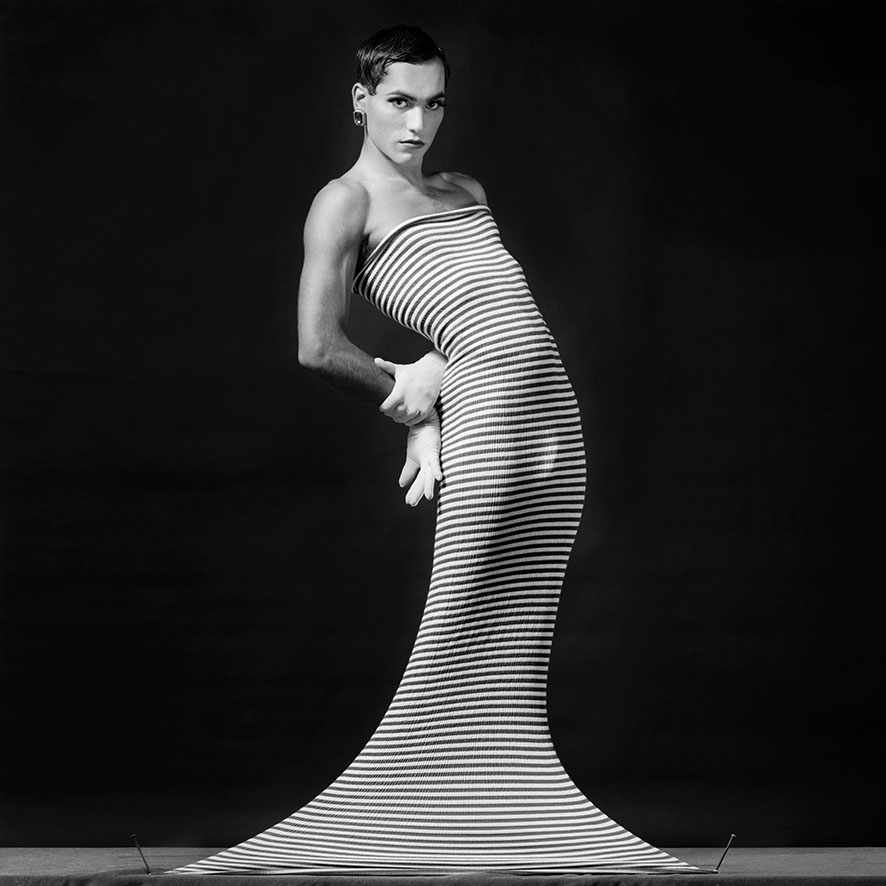
The face is not what we show — it is what we conceal. (Erwin Olaf)
Erwin Olaf (1959–2023) is one of the most important Dutch photographers. He was an exceptional artist whose photographic work not only stands out aesthetically, but also consistently provokes, moves, and raises awareness on social issues.
Following his groundbreaking exhibition at the Stedelijk Museum, Amsterdam, f³ – freiraum für fotografie presents the first comprehensive retrospective of the photographer in Berlin. Erwin Olaf – Muses is devoted entirely to the artist’s portraits—a central yet often overlooked aspect of Erwin Olaf’s oeuvre. The focus is on intimate, direct, unsparing, and at the same time stylized studies of the human being, their desires, identities, and forms of self-presentation. The exhibition deliberately forgoes Olaf’s large-scale theatrical stagings and opulent settings, instead directing attention to the faces of his protagonists as mirrors of personality—stages for emotion, vulnerability, pride, and resistance.
A central role in the exhibition is played by Erwin Olaf’s early black-and-white portraits—raw, direct, and charged with subversive energy. In these photographs, his rebellious spirit takes shape. They depict men from the Dutch gay scene, activists, drag performers, and social outsiders. As a pioneer of queer visibility, Olaf was already giving a face in the 1970s and 1980s to those who had been excluded from public life for decades. In a time marked by HIV-related stigma and conservative moral attitudes, his portraits envisioned a new queer self-image—confident, sensual, melancholic, and political. Olaf created images that were not only aesthetically striking but also carried an emancipatory potential. His series Ladies Hats, for example, plays with gender roles and sartorial attitude, celebrating a flirtation with the viewer.
In his series Squares (1983–2018), Erwin Olaf developed a new visual language: rigorously composed individual portraits that nonetheless reveal intimate moments of emotional depth. The faces of the sitters—often silent and introspective—reflect strength, determination, loss, and the pressure to conform. Precisely through this reduction to facial expression and gaze, a powerful emotional intensity emerges—one that resonates even in the absence of any elaborate setting.
Erwin Olaf also repeatedly staged himself in his photography—not out of vanity, but as an artistic act of self-examination. His self-portraits are plays with masks and reflections on aging, sexuality, illness, and transience. Particularly striking are the works he created after his lung disease: unsparing, fragile, yet never self-pitying. They stand as unembellished testimonies to mortality.
Biography
Erwin Olaf (1959, Hilversum – 2023, Groningen) was a Dutch photographer. He studied journalism at the School voor Journalistiek Utrecht before turning to photography in the early 1980s. His work has been exhibited in numerous international museums and institutions, including the Rijksmuseum Amsterdam, the Museum of Modern Art New York, the Fotomuseum Den Haag, and the Stedelijk Museum Amsterdam. Alongside his artistic practice, Olaf also worked in the commercial field. He created campaigns and editorials for international clients and magazines. He also produced official portraits, including for the Dutch royal family.
The exhibition was curated by Nadine Barth (@barthouseprojects) and Katharina Mouratidi (f³ – freiraum für fotografie), in collaboration with Shirley den Hartog (Foundation Erwin Olaf).
OPENING: Fr., June 26, 2026, 7–9 PM. Greetings: Yolande Melsert, Minister Counsellor, Embassy of the Kingdom of the Netherlands. Introduction: Nadine Barth (@barthouseprojects) in conversation with Shirley den Hartog (Foundation Erwin Olaf).
Image: Alandus from the series Squares, 1990 © Erwin Olaf / Courtesy: Galerie Ron Mandos – Amsterdam
In cooperation with

With kind support

Förderverein
f³ – freiraum für fotografie e. V.