
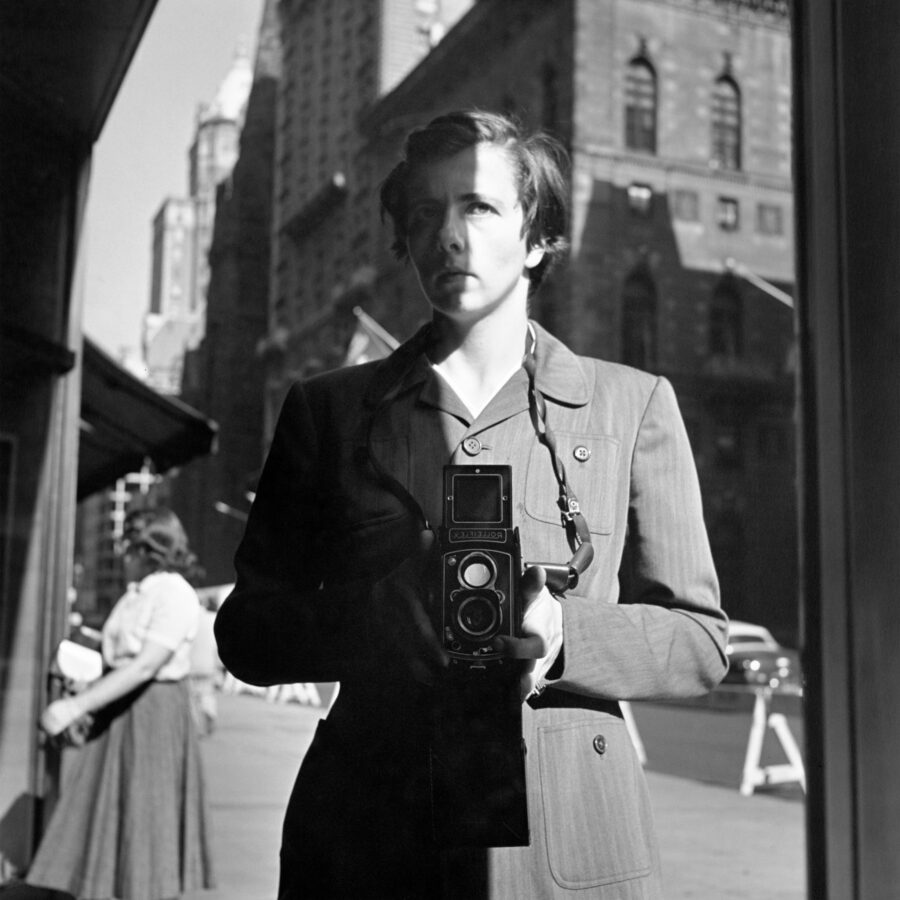
The discovery of photographer Vivian Maier (1926–2009) is considered one of the greatest sensations in the history of photography after the Second World War. The American artist was completely unknown as an artist until 2007, when real estate agent and amateur historian John Maloof auctioned off several boxes from a storage facility in Chicago, believing they contained historical photographs of the city. To his surprise, he instead came across a previously undiscovered and unexplored photographic treasure.
Vivian Maier was born in the Bronx, New York, in 1926, but spent much of her childhood and youth in France. From the early 1950s onward, she worked in the United States as a nanny and began tirelessly photographing life on the streets with a Rolleiflex camera. Recurring themes can be found throughout her work: everyday scenes, social structures, people on the margins of society, and the world of children. She had a particular fascination, however, with self-portraits. The exhibition The Self Portrait and its Double focuses on this aspect of her work.
“Self-portraits appear in Maier’s œuvre in a wide variety of forms and variations—to the point that they almost constitute a language of their own within her language. A duality. Unlike Narcissus, who destroyed himself through the contemplation and admiration of his own image, Vivian Maier’s interest in self-portraiture was more a search for her identity. Due to her social status, which reduced her to invisibility, to a kind of non-existence, she quietly and unobtrusively set out to create irrefutable proof of her presence in a world in which she seemed to have no place. Reflections of her face in a mirror or in an infinite regression, her shadow spreading across the ground, or the outline of her figure: every self-portrait by Vivian Maier is an affirmation of her presence in that particular place at that particular moment.” — Anne Morin, Curator
Over the course of some 40 years, Vivian Maier created an immense body of work estimated to comprise between 150,000 and 160,000 black-and-white negatives, several thousand color films and slides, as well as dozens of Super 8 and 16mm films, audio recordings, and everyday documents. She kept her photographic work completely private throughout her life; she showed her photographs only very rarely, and a large portion of her films were never even developed.
She died alone and impoverished in a nursing home in Chicago in 2009. In a world that had no place for women like her, the woman who remained invisible throughout her lifetime now occupies a prominent position in the history of photography, on a par with figures such as Diane Arbus, Robert Frank, Helen Levitt, and Garry Winogrand.
The exhibition was curated by Anne Morin, Director of DiChroma, Madrid.
OPENING: Fr., December 4, 2026, 7–9 PM. Speakers: Katharina Mouratidi, Artistic Director f³ – freiraum für fotografie, and Anne Morin, Director DiChroma. Admission free!

Image: New York, October 18, 1953 © Estate of Vivian Maier, Courtesy of Maloof Collection and Howard Greenberg Gallery, New York